
Published: June 16, 2026 | Category: Tech News & Industry Analysis
Introduction: The Transition from Chatbots to Infrastructure
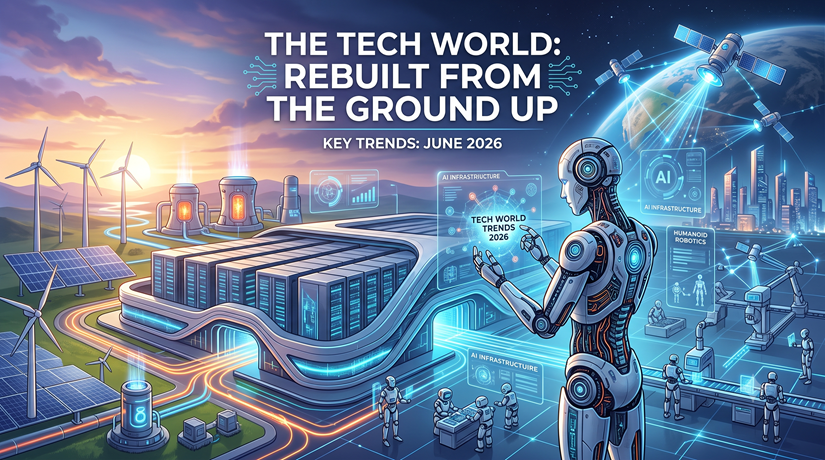
If you blinked in May, you missed a quiet but fundamental revolution in the global technology industry. In June 2026, the technology sector is no longer just iterating on consumer-grade software or shipping minor updates to conversational chat interfaces. Instead, the entire industry is being structurally rebuilt from the ground up. We are witnessing a monumental pivot where artificial intelligence is moving out of the digital ether and integrating deeply into the physical world: debt markets, local power grids, orbital satellites, automated assembly lines, and high-frequency cybersecurity defenses.
To fully understand where the industry is heading, analyzing the prominent tech world trends 2026 is presenting is absolutely essential. The AI race has evolved from a battle between software developers writing clever code into a brutal, capital-intensive contest for raw physical resources: advanced silicon chips, gigawatt-scale energy capacity, sovereign data centers, and advanced cooling systems. This comprehensive guide serves as your authoritative industry roadmap to the major shifts happening right now, offering deep technical context and strategic insights for businesses, investors, and tech enthusiasts alike.
When studying the current tech world trends 2026, one thing becomes abundantly clear: we are entering the era of physical and infrastructural AI. The decisions made by tech giants, energy regulators, and public markets this summer will dictate the economic landscape of the next decade. Let’s break down the seven pillars of this global technological restructuring.
1. The Mega AI Infrastructure Race & The Imminent Energy Crisis
The single most dominant story in technology today is the scramble to build the physical backbone of the AI era. Companies are deploying capital at a scale that is rewriting the rules of macroeconomics. In the opening weeks of June, the sheer volume of infrastructure financing reached historic highs. Alphabet led the charge by raising a staggering $80 billion in equity, while SoftBank launched a massive $52 billion data-center spending blitz across Europe. Meanwhile, China announced a $295 billion sovereign AI infrastructure push designed to secure domestic computing dominance, and OpenAI set ambitious goals to secure 10 gigawatts of dedicated power capacity for its upcoming computing clusters.
To grasp the sheer scale of these tech world trends 2026, consider the cooling and power requirements of modern hardware. A single cutting-edge AI cluster, packed with thousands of high-density GPUs, demands more power than a medium-sized metropolitan city. The industry’s rapid expansion is colliding directly with severe physical limitations, including local grid capacities, lengthy regulatory permitting hurdles, and complex global supply-chain bottlenecks.
As we analyze these massive infrastructural investments, choosing the right backend architecture and hosting environment becomes paramount for developers preparing for 2026. If you are building scalable platforms, check out our comprehensive comparison on Hostinger vs Namecheap (2026) to find the best performance-optimized infrastructure for your next project.
“The true limiting factor of the AI revolution is no longer algorithms or clean data sets; it is the physical availability of electricity and copper.”
This massive physical bottleneck has given rise to one of the most fascinating tech world trends 2026 is showing us: the intersection of AI compute and alternative energy. Microsoft, anticipating grid constraints, has actively explored partnerships with nuclear fusion and next-generation small modular reactor (SMR) plants to power its facilities. Traditional coal and gas grids are simply too slow and heavily regulated to scale at the pace of modern computing demands. The data center developers who can secure independent, clean power sources over the next eighteen months will hold an insurmountable competitive advantage in the AI market.
2. Humanoid Robots: Transitioning from Science Fiction to Factory Floor
Humanoid robotics has officially transitioned from the realm of science fiction and promotional videos into serious industrial planning and assembly-line deployment. As we analyze the physical dimensions of the tech world trends 2026, the rapid commercialization of embodied AI stands out as a massive milestone. In industrial centers across China, humanoid robots are inching closer to mass production, with factories aiming to deploy thousands of units to handle repetitive, high-precision manufacturing tasks.
A massive wave of capital is flowing into robotic engineering programs from Barcelona to Berlin. Jeff Bezos is backing a highly publicized $12 billion venture focused on building an “artificial general engineer”—an autonomous robotic system designed to handle complex engineering, maintenance, and physical troubleshooting tasks in industrial facilities. This represents a major leap from single-task robotic arms to versatile, multi-purpose machines capable of navigating dynamic human environments.
Simultaneously, Nvidia has adjusted its hardware strategy to capture this emerging market. By introducing its new Vera CPU architecture, Nvidia is providing the localized computing power necessary to run complex real-world physics simulations directly on edge devices. This chip allows robots to process visual, tactile, and spatial data with sub-millisecond latency, enabling safe and fluid human-robot collaboration on active warehouse floors. These developments represent a core pillar of the tech world trends 2026, proving that the future of artificial intelligence is physical, tangible, and highly mobile.
Industry analysts project that the period between late 2027 and early 2028 will mark the true commercial inflection point. During this window, humanoid robots are expected to move from limited pilot installations into full-scale commercial deployment, fundamentally transforming logistics, assembly manufacturing, and industrial maintenance on a global scale.
3. Apple’s Siri Reset: The Edge-to-Cloud AI Assistant is Born
At Apple’s annual WWDC 2026 keynote on Monday, June 8, the consumer tech giant delivered an incredibly comprehensive AI refresh across its entire ecosystem. This landmark event showcased how consumer-facing tech world trends 2026 are centering heavily on deeply integrated, context-aware digital assistants rather than isolated, generic chatbots. Rebuilt from the ground up, the new Siri AI represents a profound evolution of Apple’s flagship assistant, powered by the latest iteration of Apple Intelligence.
Craig Federighi, Apple’s Senior Vice President of Software Engineering, announced that Apple’s proprietary, next-generation foundation models would run seamlessly across its devices. For complex tasks requiring massive cloud-based resources, Apple has partnered with Google to run specialized Gemini models. You can read a detailed breakdown of the announcements on Mashable’s WWDC 2026 coverage. This hybrid edge-to-cloud approach represents one of the most practical and efficient architectural tech world trends 2026 has brought forward.
A key highlights of this new ecosystem is Apple’s uncompromising focus on user privacy. The new Siri runs on Private Cloud Compute (PCC), a highly advanced, zero-trust cloud intelligence system. PCC ensures that personal data sent to Apple’s private servers is cryptographically secure, completely inaccessible to third parties (and Apple itself), and continually verifiable by independent security researchers. This commitment to privacy is a highly differentiator in a market where competitors face constant scrutiny over data training policies, as explored in PCMag’s ranking of Apple’s upgrades.
Siri AI is now capable of real-time screen awareness, allowing it to understand the exact context of what you are viewing and execute actions across multiple third-party applications. This is complemented by Google’s new Gemini 3.5 Live Translate, which provides instant, voice-to-voice translation while preserving the original speaker’s natural tone, pitch, and pacing. These joint advancements signal a major shift where AI becomes an invisible, highly supportive layer of our daily digital lives.
4. The Trillion-Dollar Public Market Migration
For several years, the most valuable AI startups remained heavily shielded within private venture capital markets. However, the financial dynamics are shifting rapidly. Among the most anticipated tech world trends 2026 has delivered is the massive migration of private AI giants into public stock markets. The era of private AI unicorns relying solely on venture funding is drawing to a close, set off by a historic trio of public filings.
OpenAI formally submitted its confidential S-1 draft prospectus to the U.S. Securities and Exchange Commission (SEC) on May 22, with public confirmation following on June 8, 2026. This blockbuster filing, led by prominent underwriters Goldman Sachs, Morgan Stanley, and JPMorgan, positions the ChatGPT creator for an IPO that analysts believe could command a trillion-dollar valuation. To explore the financial intricacies, risk factors, and market implications of this debut, check out the AP News OpenAI S-1 breakdown.
While the revenue numbers are astronomical—climbing from $2 billion in 2023 to an estimated run rate of over $25 billion in 2026—the financial reports reveal a staggering cash burn rate. Due to rising GPU inference costs, which are projected to reach $14.1 billion in 2026 alone, OpenAI is reportedly losing more than $1.20 for every single dollar of revenue it generates. This complex financial structure makes their public debut one of the most closely watched market events in modern tech history.
Simultaneously, SpaceX launched its highly anticipated public offering on June 12, 2026, trading under the ticker symbol SPCX on the NASDAQ. This historic launch raised $75 billion at an implied valuation of $1.77 trillion, making it the largest stock market debut ever recorded. The details of this massive float are analyzed in The Guardian’s SpaceX IPO feature. SpaceX’s successful listing, combined with Anthropic’s confidential S-1 filing on June 1, proves that public market investors are highly eager to fund the expensive, infrastructure-heavy future of AI and space-based edge computing.
You can track the ongoing market performance and trading history of these newly public shares on the Forge Global SPCX tracking page, which details the immediate market action following the June 12 debut. These market moves confirm that tech world trends 2026 are rapidly transforming speculative AI investments into highly scrutinized, publicly traded assets.
5. Wearable Tech: Reclaiming Health with Aesthetic Precision
On the consumer hardware front, the market is undergoing a quiet, highly stylish revolution. As we evaluate the latest product launches, one of the most refreshing tech world trends 2026 offers is the convergence of advanced health tracking and premium product design. The days of bulky plastic fitness trackers are officially behind us, replaced by sleek, materials-focused wearables that blend seamlessly into a professional wardrobe.
The defining launches of the season include ultra-compact smart rings featuring continuous, clinical-grade blood pressure monitoring and high-fidelity biosensors. These devices offer users highly detailed insights into their cardiovascular health, sleep stages, and recovery metrics without sacrificing style or comfort. This emphasis on wellness highlights a major theme: consumers want technology that quietly improves their quality of life, rather than constantly demanding their attention with screens and notifications.
We are also seeing this dedication to premium aesthetics across other hardware categories. High-end carbon fiber laptops, designed for extreme durability and ultra-lightweight portability, are becoming the standard for mobile professionals. Simultaneously, smartphones are embracing striking triple-camera arrays with oversized glass lenses, prioritizing professional-grade mobile photography over pure software optimization. This aesthetic shift is a key element of the tech world trends 2026, where physical engineering and tactile satisfaction are highly valued once again.
Additionally, specialized entertainment hardware is enjoying a significant resurgence. High-comfort, low-cost retro gaming headsets and next-generation sports watches are finding massive audiences. These devices combine nostalgic interfaces with modern, AI-optimized performance, offering highly immersive experiences for casual gamers and elite athletes alike. This diverse product landscape proves that consumer tech is becoming highly personalized, focusing on long-term wellness, comfort, and direct utility.
6. Enterprise Cybersecurity: AI-Driven Threats Confronting Zero-Trust Defenses
As digital ecosystems become more complex, security frameworks are being tested like never before. Cybersecurity is a critical battleground within the tech world trends 2026, characterized by a rapid, AI-fueled arms race. Enterprise networks are facing a sharp rise in highly sophisticated, automated attacks, with cybercriminal networks leveraging specialized machine learning models to identify and exploit software vulnerabilities faster than traditional defenses can react.
Fintech platforms and high-volume transaction networks are experiencing a significant uptick in highly targeted zero-day exploits. Additionally, AI-driven social engineering attacks—including hyper-realistic deepfake voice clones and automated, highly personalized phishing campaigns—are bypassing traditional security training and email filters. Account hijackings have become increasingly common, forcing security teams to abandon legacy perimeter defenses and adopt strict, continuous zero-trust verification models.
Fortunately, defensive technologies are evolving rapidly to counter these threats. Security teams are deploying advanced AI models directly at the network edge to monitor system behavior in real time, identify anomalous patterns, and automatically quarantine suspicious assets before a breach can spread. However, the rise of defensive AI represents just one side of a broader shift in the security landscape.
New open-platform regulations in Europe and North America are forcing previously locked digital ecosystems to open up, giving users greater control over their data and software choices. While these legislative efforts encourage market competition, they also introduce new security challenges. Securing decentralized, open-platform environments will be one of the most complex, defining tech world trends 2026 security professionals must navigate, requiring a highly disciplined approach to threat modeling and system monitoring.
7. The Socioeconomic Reality: AI Efficiency vs. Structural Workplace Shifts
While tech giants continue to post historic revenues and record-breaking profits, the tech industry’s labor market is experiencing a period of intense structural adjustment. A closer look at the tech world trends 2026 reveals a complex employment landscape, with tech layoffs averaging nearly 1,000 workers per day. Many corporate executives point directly to AI-driven efficiency and automated workflows as the primary reason for these ongoing workforce reductions.
However, industry analysts and labor economists suggest that this narrative is highly simplified. There is growing consensus that many tech companies are using AI as a convenient public justification to correct for the dramatic over-hiring that occurred during the pandemic boom of 2021 to 2023. By restructuring their workforces under the banner of technological innovation, organizations can streamline operations, reduce overhead, and appease public market investors who demand high margins and lean operations.
This structural shift has created a highly visible wealth and skills gap within the technology sector. Early employees at high-valuation AI companies, specialized machine learning researchers, and cloud infrastructure engineers are commanding historic compensation packages and equity options. Meanwhile, generalist software developers, content writers, and middle-management professionals face a highly competitive job market with flat wage growth and increased contract-based employment.
This polarization of the tech workforce is a highly significant socioeconomic trend. Re-skilling programs, focused on teaching traditional professionals how to effectively orchestrate AI agents and manage complex cloud environments, are growing rapidly. This emphasizes a key reality of the tech world trends 2026: the job market is not simply shrinking; it is being aggressively reallocated toward specialized, infrastructure-literate talent.
Comparative Data: The Structural Landscape of June 2026
To help visualize how these monumental tech world trends 2026 are reshaping the global market, let’s examine the concrete data behind the current infrastructure race, capital allocations, and product features.
Table 1: The Global AI Infrastructure Capital Surge
| Entity / Nation | Capital Allocated (USD) | Primary Strategic Focus | Expected Key Milestones (2026-2027) |
|---|---|---|---|
| China | $295 Billion | Sovereign computing infrastructure and domestic chip plants | Full independent supply chain for domestic AI models | Alphabet | $80 Billion | Hyperscale cloud expansion and proprietary TPU deployment | Global rollout of context-aware Google Gemini integrations |
| SoftBank | $52 Billion | European data center and edge computer clusters | Sovereign European AI compute networks |
| OpenAI | $10 Billion+ (Target) | 10 Gigawatt power generation for core compute clusters | Securing independent nuclear and modular reactor partnerships |
Table 2: Financial Metrics of the 2026 IPO Wave
| Company | Ticker (Market) | IPO Date / Filing Status | Implied Valuation | Primary Underwriters / Strategic Backers |
|---|---|---|---|---|
| SpaceX | SPCX (NASDAQ) | Listed: June 12, 2026 | $1.77 Trillion | 82.4% voting power retained by Elon Musk |
| OpenAI | S-1 (Confidential) | Confirmed: June 8, 2026 | $1.0+ Trillion (Target) | Goldman Sachs, Morgan Stanley, JPMorgan Chase |
| Anthropic | S-1 (Confidential) | Filed: June 1, 2026 | $150+ Billion (Target) | Amazon, Google, and strategic venture funds |
Conclusion: Preparing for the Physical AI Future
In wrapping up our deep dive into the most profound tech world trends 2026 has introduced, the overarching message is clear: the technology landscape has permanently evolved beyond speculative software applications. Artificial intelligence is no longer an abstract digital tool or a conversational companion living inside your web browser. It is a highly integrated, resource-intensive infrastructure engine that is actively reshaping global energy grids, physical manufacturing floors, and public equity markets.
For business leaders, developers, and investors, staying ahead of these tech world trends 2026 requires a fundamental shift in perspective. To succeed in this new environment, organizations must look beyond basic software integration and focus heavily on infrastructure security, sustainable power sourcing, clean edge-to-cloud architectures, and highly disciplined data privacy standards. The future of technology is being actively built in the physical world today—and those who adapt to this tangible, infrastructure-focused paradigm will lead the global market tomorrow.
Frequently Asked Questions (FAQ)
Q1: What is the most significant tech world trends 2026 is presenting right now?
A1: The most critical trend is the massive shift toward physical AI infrastructure. Tech giants are spending hundreds of billions of dollars to secure raw computing power, specialized silicon chips, and dedicated energy grids (such as nuclear and modular reactor installations) to sustain the massive growth of generative AI models.
Q2: When did SpaceX go public, and what was its market valuation?
A2: SpaceX completed its historic initial public offering on June 12, 2026, listing on the NASDAQ under the ticker symbol SPCX. The blockbuster listing raised $75 billion, valuing the aerospace and orbital computing giant at approximately $1.77 trillion.
Q3: How is Apple addressing data privacy with the new Siri AI?
A3: Apple’s upgraded Siri assistant runs on Private Cloud Compute (PCC). This advanced architecture ensures that any user data processed off-device is cryptographically protected, completely inaccessible to anyone (including Apple), and continually verifiable by independent third-party security researchers.
Q4: Why is there an energy crisis associated with AI data centers?
A4: Modern AI models require immense computational power for both training and continuous real-time inference. The sheer density of modern GPU clusters consumes vast amounts of electricity, putting severe strain on local utility grids and forcing tech companies to seek direct partnerships with clean energy providers.
Q5: How are tech world trends 2026 impacting the global job market?
A5: While AI-driven automation is accelerating structural layoffs in certain sectors, tech companies are also actively adjusting their workforces following massive hiring waves from previous years. The job market is rapidly reallocating capital toward highly specialized talent, particularly in cloud infrastructure, edge computing, robotics, and cyber defense.