
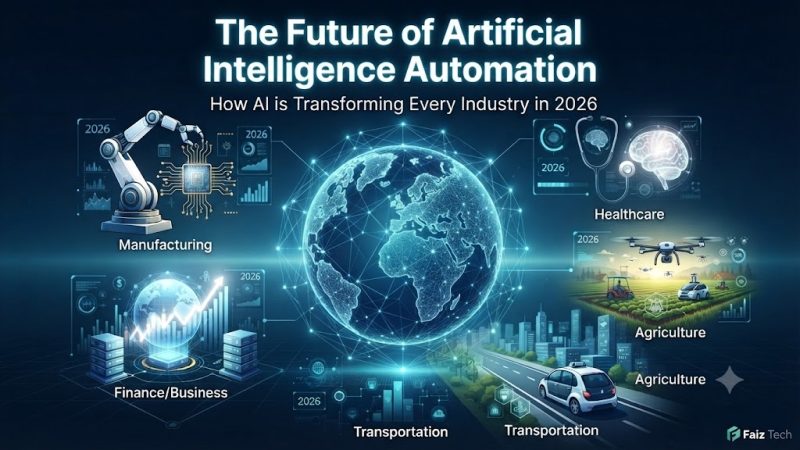
Technology is evolving faster than ever before, and one innovation is leading this transformation—Artificial Intelligence Automation. Businesses, governments, schools, hospitals, and even individuals are using intelligent systems to complete tasks faster, reduce costs, and improve decision-making.
In 2026, Artificial Intelligence Automation is no longer just a futuristic concept. It has become a practical solution that powers smart assistants, self-driving vehicles, customer support chatbots, healthcare diagnostics, cybersecurity, financial analysis, and countless other applications.
Whether you are a business owner, student, freelancer, or technology enthusiast, understanding Artificial Intelligence Automation is essential because it will influence nearly every profession in the coming years.
This comprehensive guide explains what Artificial Intelligence Automation is, how it works, why it matters, and how it is changing industries across the world.
What Is Artificial Intelligence Automation?
Artificial Intelligence Automation is the combination of Artificial Intelligence (AI) and automation technologies to perform tasks with little or no human intervention.
Traditional automation follows fixed rules. Artificial Intelligence Automation goes much further by allowing systems to:
- Learn from data
- Recognize patterns
- Make intelligent decisions
- Predict future outcomes
- Improve continuously over time
Unlike simple software that performs repetitive tasks, AI-powered automation can adapt to new situations and solve complex problems.
For example:
- Gmail automatically filters spam emails.
- Netflix recommends movies based on your interests.
- ChatGPT answers questions naturally.
- Google Maps predicts traffic conditions.
- Banks detect fraudulent transactions instantly.
All of these are examples of Artificial Intelligence Automation in everyday life.
Why Artificial Intelligence Automation Matters
The digital economy depends heavily on speed, efficiency, and accurate decision-making. Companies that adopt Artificial Intelligence Automation can complete work faster while reducing operational costs.
Here are some reasons why AI automation has become essential:
Increased Productivity
Artificial Intelligence Automation performs repetitive tasks 24 hours a day without becoming tired.
Employees can focus on:
- Creative thinking
- Problem solving
- Customer relationships
- Business strategy
Instead of replacing humans entirely, AI often helps people become more productive.
Better Decision-Making
Modern AI systems analyze millions of data points within seconds.
Businesses use Artificial Intelligence Automation to:
- Predict customer behavior
- Improve marketing campaigns
- Forecast sales
- Manage inventory
- Reduce business risks
Data-driven decisions are usually more accurate than guesswork.
Faster Customer Service
AI-powered chatbots answer customer questions instantly.
Benefits include:
- 24/7 support
- Faster response times
- Lower support costs
- Improved customer satisfaction
Companies around the world now rely on intelligent virtual assistants to handle thousands of conversations simultaneously.
Cost Reduction
One of the biggest advantages of Artificial Intelligence Automation is reducing operational expenses.
Businesses save money by automating:
- Data entry
- Invoice processing
- Customer support
- Document management
- Email responses
- Appointment scheduling
These savings allow companies to invest more in innovation.
How Artificial Intelligence Automation Works
Artificial Intelligence Automation combines multiple technologies into one intelligent system.
The process generally includes the following steps.
1. Data Collection
Every AI system begins with data.
Sources include:
- Customer information
- Website analytics
- Images
- Videos
- Sensors
- Documents
- Financial records
The quality of AI depends on the quality of the available data.
2. Machine Learning
Machine Learning teaches computers how to identify patterns.
Instead of programming every rule manually, developers train AI models using historical data.
Over time, the system becomes more accurate.
Examples include:
- Product recommendations
- Fraud detection
- Weather forecasting
- Disease prediction
3. Decision Making
Once trained, AI analyzes new information and selects the best possible action.
For example:
An online shopping website may recommend products based on:
- Previous purchases
- Browsing history
- Customer preferences
- Popular trends
This process happens automatically within milliseconds.
4. Continuous Learning
Unlike traditional software, Artificial Intelligence Automation improves over time.
As more data becomes available, AI systems become smarter and more accurate.
This ability makes AI one of the most powerful technologies ever developed.
Key Technologies Behind Artificial Intelligence Automation
Several technologies work together to create intelligent automation.
Machine Learning
Machine Learning allows computers to learn from data instead of relying only on programmed instructions.
Applications include:
- Fraud detection
- Sales forecasting
- Recommendation engines
- Medical diagnosis
Natural Language Processing (NLP)
Natural Language Processing helps computers understand human language.
Examples include:
- ChatGPT
- Voice assistants
- Language translation
- Email classification
- Speech recognition
NLP has dramatically improved customer service and digital communication.
Computer Vision
Computer Vision enables machines to interpret images and videos.
It is widely used in:
- Face recognition
- Medical imaging
- Autonomous vehicles
- Security surveillance
- Quality inspection
Robotic Process Automation (RPA)
RPA automates repetitive office tasks.
Examples include:
- Copying data
- Filling forms
- Invoice processing
- Payroll management
- Report generation
When RPA combines with Artificial Intelligence Automation, businesses achieve even greater efficiency.
Deep Learning
Deep Learning is an advanced branch of machine learning that uses neural networks inspired by the human brain.
Applications include:
- Voice assistants
- Medical diagnosis
- Image recognition
- Autonomous driving
- Language generation
Benefits of Artificial Intelligence Automation
Organizations worldwide are investing billions of dollars in Artificial Intelligence Automation because the benefits are enormous.
Higher Accuracy
AI reduces human error by performing calculations consistently.
Examples include:
- Banking
- Healthcare
- Engineering
- Scientific research
Faster Work
Tasks that previously required several hours can now be completed within seconds.
Examples include:
- Data analysis
- Customer support
- Content recommendations
- Financial reporting
Improved Customer Experience
Customers expect quick responses.
Artificial Intelligence Automation helps businesses deliver:
- Personalized recommendations
- Faster support
- Better online shopping
- Customized marketing
Happy customers often become loyal customers.
Better Cybersecurity
Cybersecurity systems powered by Artificial Intelligence Automation can detect suspicious activities before they become serious attacks.
AI continuously monitors:
- Networks
- Emails
- User behavior
- Login attempts
This proactive approach improves digital security.
Business Growth
Businesses that adopt Artificial Intelligence Automation often experience:
- Increased productivity
- Higher profits
- Faster innovation
- Better customer satisfaction
- Competitive advantage
Artificial Intelligence Automation in Healthcare
Healthcare has experienced one of the biggest transformations through Artificial Intelligence Automation.
Doctors now use AI to assist in diagnosing diseases more accurately.
Examples include:
- Detecting cancer from medical images
- Predicting heart disease
- Monitoring patients remotely
- Developing new medicines
- Managing hospital resources
Hospitals also use AI-powered robots to transport supplies, assist surgeries, and improve patient care.
As technology advances, healthcare is expected to become even more personalized and efficient.
Artificial Intelligence Automation in Education
Education is becoming smarter with AI-powered learning systems.
Students now receive personalized learning experiences based on their progress.
Artificial Intelligence Automation supports:
- Adaptive learning platforms
- Intelligent tutoring systems
- Automatic grading
- Language translation
- Student performance analysis
Teachers can spend more time teaching while AI handles repetitive administrative tasks.
Artificial Intelligence Automation in Business
Businesses of all sizes are using Artificial Intelligence Automation to improve productivity.
Popular business applications include:
- Customer service chatbots
- Email automation
- Sales forecasting
- Marketing personalization
- Inventory management
- Fraud detection
- Human resource management
Companies that embrace AI often respond faster to market changes and customer needs.
Artificial Intelligence Automation in Manufacturing
Modern factories are becoming increasingly intelligent through Artificial Intelligence Automation.
Smart manufacturing uses AI to:
- Predict equipment failures before they occur
- Improve production quality
- Reduce waste
- Optimize supply chains
- Increase workplace safety
Industrial robots can work around the clock, performing repetitive tasks with high precision while reducing production costs.
Artificial Intelligence Automation in Finance
The financial industry has rapidly adopted Artificial Intelligence Automation to improve security, customer service, and decision-making. Banks, insurance companies, and investment firms now rely on AI to process millions of transactions every day with greater speed and accuracy.
Fraud Detection
One of the most valuable uses of Artificial Intelligence Automation is identifying suspicious financial activities in real time. AI systems can analyze transaction patterns and immediately flag unusual behavior, helping prevent fraud before significant losses occur.
Smart Investment
Investment firms use AI-powered algorithms to analyze market trends, company performance, and economic indicators. This enables investors to make more informed decisions while reducing risks.
Customer Banking
Modern banking apps use AI chatbots that can:
- Answer customer questions
- Block lost credit cards
- Check account balances
- Schedule payments
- Recommend financial products
These features improve customer satisfaction while reducing operational costs.
Artificial Intelligence Automation in Retail
Retail businesses are using Artificial Intelligence Automation to create better shopping experiences both online and in physical stores.
Personalized Recommendations
E-commerce websites analyze customer behavior to recommend products that match individual preferences. Personalized recommendations increase sales while helping customers discover products they are likely to purchase.
Inventory Management
AI predicts future demand based on:
- Seasonal trends
- Historical sales
- Customer behavior
- Market conditions
This helps retailers avoid overstocking or running out of popular products.
Smart Pricing
Artificial Intelligence Automation continuously monitors competitors, demand, and market conditions to adjust prices automatically, maximizing profitability.
Artificial Intelligence Automation in Agriculture
Agriculture is becoming smarter through Artificial Intelligence Automation, enabling farmers to increase crop yields while reducing waste.
Precision Farming
AI systems collect data from satellites, drones, and soil sensors to determine:
- Soil moisture
- Nutrient levels
- Weather conditions
- Crop health
Farmers can then make better decisions about irrigation and fertilization.
Disease Detection
Computer vision systems identify plant diseases early, allowing farmers to treat affected crops before the disease spreads.
Automated Equipment
Modern farms use autonomous tractors and harvesting machines that improve efficiency while reducing labor costs.
Artificial Intelligence Automation in Transportation
Transportation is another industry being transformed by Artificial Intelligence Automation.
Self-Driving Vehicles
Autonomous vehicles rely on AI to:
- Detect obstacles
- Recognize traffic signs
- Stay within lanes
- Avoid collisions
- Plan efficient routes
Although fully autonomous transportation is still developing, significant progress has already been made.
Traffic Management
Cities use AI-powered traffic systems to reduce congestion by adjusting traffic signals based on real-time conditions.
Logistics Optimization
Delivery companies use Artificial Intelligence Automation to determine the fastest and most cost-effective routes, reducing fuel consumption and improving delivery times.
Artificial Intelligence Automation in Cybersecurity
As cyber threats continue to evolve, Artificial Intelligence Automation has become essential for protecting businesses and individuals.
AI systems monitor networks continuously to detect unusual activities that may indicate malware, phishing attempts, or unauthorized access.
Key cybersecurity applications include:
- Threat detection
- Malware identification
- Email filtering
- Identity verification
- Network monitoring
- Automated incident response
By responding to threats in seconds, AI significantly reduces the impact of cyberattacks.
Future Trends of Artificial Intelligence Automation (2026–2030)
Experts predict that Artificial Intelligence Automation will become even more integrated into daily life over the next several years.
1. AI Agents
AI agents will perform complex tasks such as planning projects, managing schedules, conducting research, and interacting with multiple software applications on behalf of users.
2. Smarter Healthcare
Future AI systems will assist doctors with earlier disease detection, personalized treatment plans, and remote patient monitoring.
3. Intelligent Robots
Robots will become more capable of working safely alongside humans in manufacturing, warehouses, hospitals, and homes.
4. Hyper-Personalization
Businesses will use Artificial Intelligence Automation to provide highly personalized products, services, and marketing experiences based on individual preferences.
5. Sustainable Technology
AI will help reduce energy consumption, optimize renewable energy systems, and improve environmental sustainability through smarter resource management.
Challenges of Artificial Intelligence Automation
Despite its many benefits, Artificial Intelligence Automation also presents several challenges.
Job Displacement
Automation may replace certain repetitive jobs. However, it is also creating new careers in AI development, data science, cybersecurity, and digital transformation.
Data Privacy
AI systems require large amounts of data, making privacy and data protection essential concerns.
Ethical Decision-Making
Organizations must ensure AI systems are fair, transparent, and free from harmful bias.
Cybersecurity Risks
While AI strengthens security, cybercriminals can also misuse AI to create more advanced attacks. Continuous security improvements are necessary.
Best AI Tools in 2026
Many AI tools are helping businesses and individuals improve productivity.
Some of the most popular include:
- ChatGPT
- Google Gemini
- Microsoft Copilot
- Claude AI
- Perplexity AI
- Midjourney
- GitHub Copilot
- Notion AI
- Canva AI
- Grammarly AI
Each tool focuses on different tasks such as writing, coding, design, research, or productivity.