
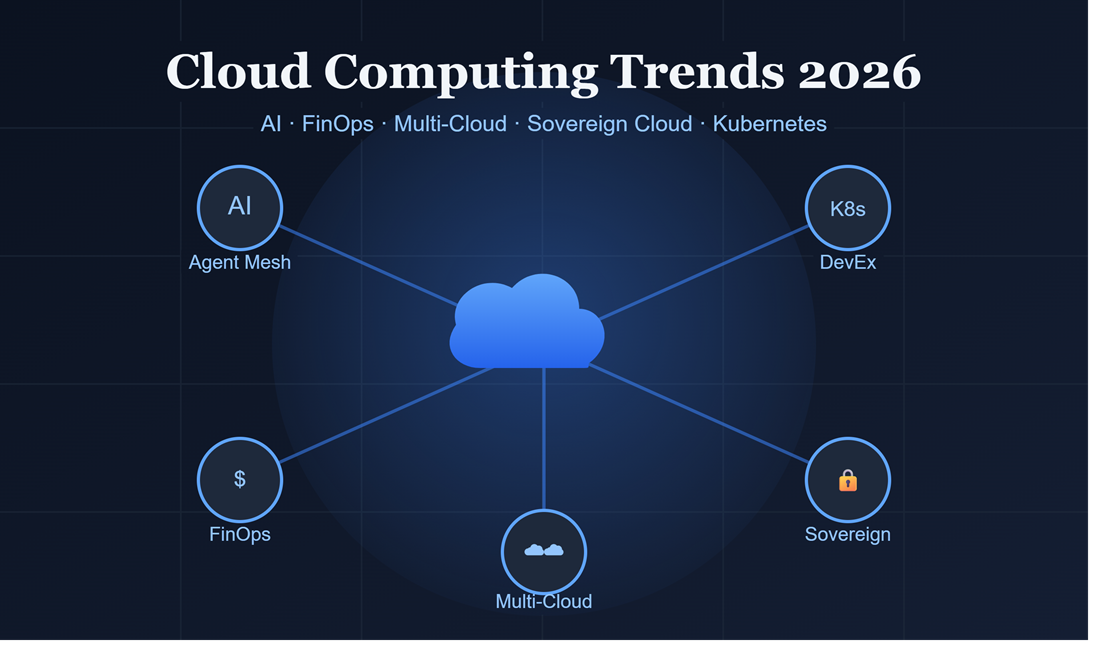
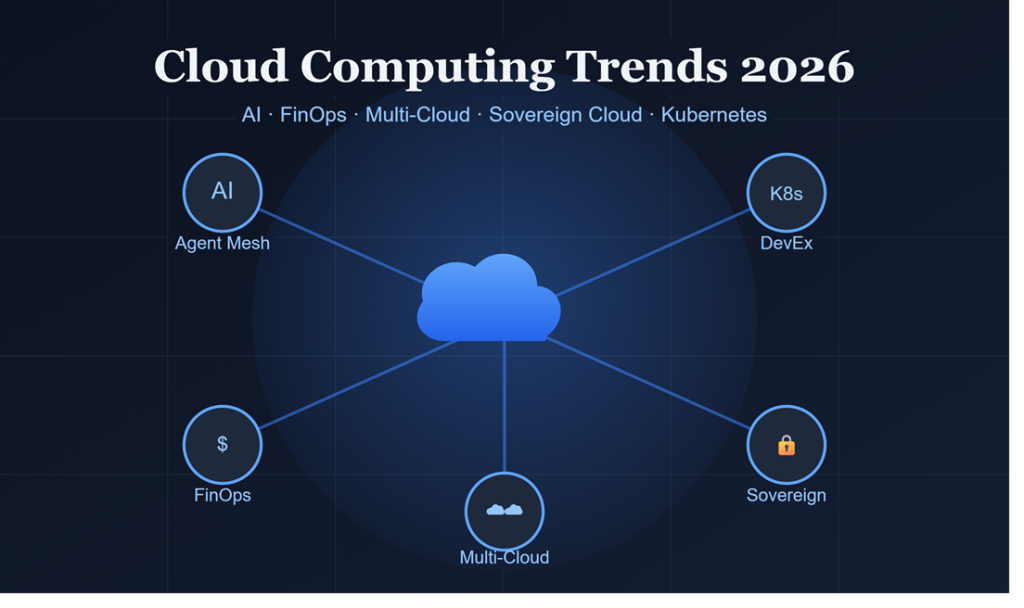
The cloud computing landscape is undergoing a massive paradigm shift, and the cloud computing trends 2026 are bringing to the surface look nothing like the migration-focused conversations of a decade ago. After years focused purely on moving workloads off on-premises servers and into the public cloud, we have officially entered a new era. The conversation has completely shifted from “where your data runs” to “how adaptable your architecture is.”
As organizations stop chasing surface-level tech hype and start demanding real return on investment (ROI), cloud architectures are being rebuilt from the ground up. Driven by massive breakthroughs in artificial intelligence, tightening global data regulations, and rising resource costs, here are the cloud computing trends 2026 that are defining the tech world this year — backed by real data from Gartner and Flexera’s latest research.
What Are the Biggest Cloud Computing Trends 2026 Right Now?
According to Gartner’s latest public cloud forecast, worldwide public cloud spending is projected to grow 21.3% in 2026 as AI integration accelerates demand — a clear signal that the cloud computing trends 2026 are being driven as much by AI infrastructure needs as by traditional migration goals. Below, we break down the five shifts every IT leader should be tracking.
1. Cloud 3.0: Optimizing Infrastructure for AI and “Agent Meshes”
Artificial intelligence is breaking traditional cloud assumptions, and it’s arguably the single biggest force behind this year’s cloud computing trends 2026. In the past, companies relied heavily on “elastic compute” — the ability to scale processing power up and down instantly. However, scaling an AI model isn’t that simple. High-powered Graphic Processing Units (GPUs) are incredibly expensive, and letting them sit idle due to data bottlenecks ruins a company’s cloud budget.
The Rise of the AI Agent Mesh
We are moving beyond basic chatbots to highly complex, autonomous AI agents that handle enterprise workflows. Because these agents constantly talk to multiple large language models (LLMs) and databases, cloud engineers are now implementing AI Agent Meshes — one of the more technical but increasingly essential components of modern cloud computing trends 2026.
An agent mesh acts as a central infrastructure hub that:
- Controls and governs how AI agents interact with each other.
- Enforces security protocols to prevent sensitive corporate data leaks.
- Routes requests to the most cost-effective cloud models to minimize processing bills.
Shifting from Experimentation to Production
The era of launching experimental AI pilots just for show is over. Tech leaders are strategically separating AI training from AI inference. While massive models might still be trained on core public clouds, the day-to-day running of those models (inference) is being moved closer to the actual data sources to reduce network latency and sky-high storage fees — a pattern that’s quickly becoming standard practice across the cloud computing trends 2026 we’re seeing enterprise-wide.
2. The Rise of FinOps and “GreenOps” (Cloud Cost & Sustainability)
Cloud pricing has become a major challenge for modern enterprises, and cost discipline is one of the clearest cloud computing trends 2026 we’re tracking this year. Expensive network configurations, data storage latency, and unpredictable AI processing runs have turned “pay-as-you-go” pricing into a source of financial surprise. Consequently, FinOps (Financial Operations) has graduated from a niche corporate framework to a critical design discipline.
Predictability Over Elasticity
Modern finance and engineering teams are working hand-in-hand to replace variable cloud costs with predictable infrastructure spending. Organizations are actively migrating away from unpredictable, open-ended cloud billing models. Instead, they are prioritizing:
- Reserved and Spot Instances: Securing upfront server capacity at deep discounts.
- Data Egress Optimization: Minimizing the hidden, aggressive fees cloud providers charge when moving data out of their networks.
The Emergence of GreenOps
Hand-in-hand with financial budgeting is the rise of GreenOps (Sustainability Operations) — a theme that’s quietly become one of the more overlooked cloud computing trends 2026 despite its growing budget impact. Data centers are massive consumers of water and electrical power. With global power demands scaling sharply alongside dense GPU clusters, sustainability tracking is now built directly into top-tier cloud management platforms. Choosing cloud configurations based on carbon footprints, liquid cooling availability, and energy efficiency is no longer just a public relations move — it is a cost-saving necessity.
3. Hybrid and Multi-Cloud Architectures Become the Default
The old debate of “Public Cloud vs. On-Premises Data Centers” is officially dead, and hybrid strategy is one of the most consistent cloud computing trends 2026 across companies of every size. Hybrid and multi-cloud environments are no longer a compromise made by slow-moving industries; they are now the leading enterprise standard. According to Flexera’s 2026 State of the Cloud Report, 73% of organizations now operate hybrid cloud environments, with multi-cloud adoption continuing to climb year-over-year as well.
[Public Cloud Bursting] <---> [Central Cloud Orchestration] <---> [On-Premise Private Cloud]Avoiding Vendor Lock-In
Relying entirely on a single hyperscaler (like AWS, Microsoft Azure, or Google Cloud) exposes an organization to immense risks, including sudden price hikes, localized outages, and rigid technical boundaries. By spreading workloads across multiple providers, companies retain maximum leverage, ensuring they can seamlessly shift tasks to whoever offers the best performance and price at any given moment.
The Renaissance of Cloud Repatriation
Surprisingly, some workloads are actually leaving the public cloud entirely. Known as cloud repatriation, businesses are moving steady-state, highly predictable workloads back onto private infrastructure or colocation leases. When an application runs 24/7 with the exact same data needs, running it on custom hardware is often vastly cheaper than renting public cloud space indefinitely.
4. Sovereign Clouds and Hyper-Strict Data Compliance
As data privacy regulations tighten around the world, the physical location of a cloud server matters more than ever, making data sovereignty one of the fastest-growing cloud computing trends 2026. Laws like the European Union’s landmark AI Act, GDPR, and updated global cyber directives mean that multinational corporations can no longer treat cloud storage as a borderless entity. Gartner forecasts that worldwide sovereign cloud infrastructure spending will grow 35.6% in 2026 alone, underlining how quickly this shift is accelerating.
What is a Sovereign Cloud?
A Sovereign Cloud is a specialized cloud architecture designed to ensure that all data — including metadata, backups, and logs — remains strictly within a specific geographic jurisdiction or nation-state. This prevents foreign entities or outside legal jurisdictions from accessing sensitive data assets.
Confidential Computing Takes Center Stage
To protect data while it is actively being used, the market is quickly adopting confidential computing. Traditional security measures encrypt data while it sits on a hard drive (at rest) or travels through the internet (in transit). Confidential computing goes a step further by encrypting data while it is being processed in the CPU memory. This makes it virtually impossible for unauthorized users, or even the cloud provider itself, to peek at data during operational runs.
5. Kubernetes Shifts to the Background (Prioritizing Developer Experience)
For years, Kubernetes was the absolute star of cloud-native engineering. If you wanted to run scalable container applications, developers had to learn complex, manual Kubernetes configurations. This year, the industry is experiencing “open-source fatigue,” shifting focus heavily toward Developer Experience (DevEx) — a quieter but important thread running through the broader cloud computing trends 2026.
Hiding the Complexity Under the Hood
Kubernetes hasn’t disappeared; it has simply moved to the back seat. It is now treated like the engine under the hood of a car — vital, but hidden from the driver.
Platform engineering teams are implementing advanced abstraction tools and self-service APIs (using projects like Crossplane and Kratix). This allows software developers to deploy, test, and scale their code seamlessly through simple internal dashboards without ever having to touch raw infrastructure code or complex cluster mechanics.
The Sunset of Local Dev Environments
As cloud architectures have grown incredibly intricate, running a copy of a modern tech stack locally on a laptop has become inefficient and slow. The new standard centers on production-like cloud development environments, another shift firmly on the list of cloud computing trends 2026 worth watching. Developers now write code locally but run and test it inside secure, isolated sandboxes hosted directly in the cloud, removing the classic bottleneck of waiting for continuous integration (CI) pipelines to finish building.
The Numbers Behind Cloud Computing Trends 2026
It helps to ground these shifts in real data. Here’s what the analyst firms are reporting:
- Worldwide public cloud spending is forecast to grow 21.3% in 2026, reaching roughly $850 billion, according to Gartner.
- 73% of organizations now operate hybrid cloud environments, per Flexera’s 2026 State of the Cloud Report.
- Sovereign cloud infrastructure spending is projected to grow 35.6% year-over-year in 2026, according to Gartner.
- Wasted cloud spend has risen to 29%, its first increase in five years, largely driven by unpredictable AI workload costs.
These figures make clear that the cloud computing trends 2026 we’ve outlined aren’t speculative — they’re already reshaping enterprise budgets and architecture decisions today.
Why These Cloud Computing Trends 2026 Matter for Your Business
Understanding the cloud computing trends 2026 isn’t just an academic exercise for IT leaders — it has direct implications for budgeting, hiring, and architecture decisions made this year:
- Budget planning needs to account for AI-driven cost volatility, not just traditional compute and storage.
- Compliance teams need to get ahead of sovereign cloud requirements before they become a blocker for international expansion.
- Engineering teams should expect less hands-on Kubernetes work and more emphasis on developer-friendly abstraction layers.
- Procurement strategies should assume multi-cloud and hybrid environments as the default, not the exception.
Companies that treat the cloud computing trends 2026 as a checklist to react to, rather than a framework to plan around, tend to fall behind competitors who build flexibility into their architecture from day one.
Frequently Asked Questions About Cloud Computing Trends 2026
Do small and midsize businesses need to worry about these trends, or is this just enterprise-level stuff? Most of the cloud computing trends 2026 we’ve covered — especially FinOps discipline and hybrid architecture choices — apply just as much to smaller teams. You don’t need Fortune 500 scale to benefit from avoiding vendor lock-in or catching wasted cloud spend early.
Which trend should businesses prioritize first? For most organizations, FinOps and cost visibility deliver the fastest, most measurable return among this year’s shifts, since unpredictable AI-driven billing is already affecting budgets across company sizes.
Conclusion: Building for Durability, Not Drama
Cloud computing is maturing, and the cloud computing trends 2026 reflect an industry that has moved past chasing flashy, unproven platforms. Instead, organizations are investing heavily in simplicity, portability, and structural resilience.
Whether you are looking to build highly advanced AI frameworks, shield your systems from aggressive global compliance penalties, or tightly optimize your IT budget, the objective remains exactly the same: building systems that adapt gracefully to real-world operational constraints. The cloud computing trends 2026 we’ve covered here all point toward the same conclusion — the future of the cloud belongs to those who value durability over hype.