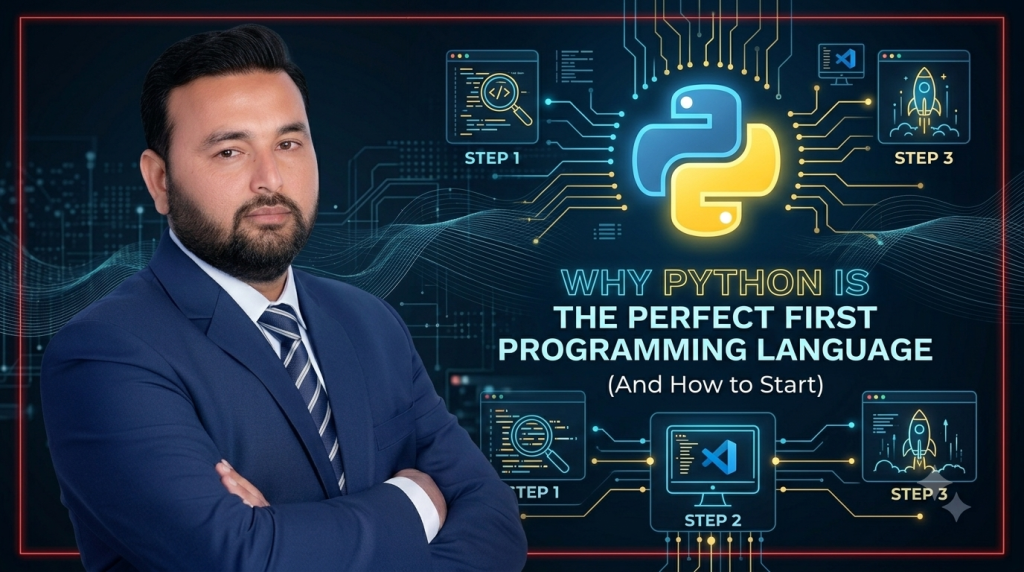
Learning to code is one of the most rewarding decisions you can make. Whether you want to switch careers, automate your daily tasks, or dive into the world of Artificial Intelligence (AI), programming opens doors to endless opportunities.
However, walking into the world of programming can feel incredibly overwhelming. There are hundreds of programming languages out there—Java, C++, JavaScript, Rust, Go, and Python, just to name a few. If you choose the wrong language as a beginner, you might get frustrated by confusing rules, lose motivation, and quit before you even build your first project.
That is where Python for beginners comes in.
Python has become the undisputed favorite for beginners worldwide. In this comprehensive guide, we will look at exactly why Python for beginners is the perfect starting point and give you a step-by-step roadmap on how to start writing your own code today.
Why Python for Beginners Beats Other Languages
Think of learning a programming language like learning to drive a car. If you try to learn how to drive using a massive, manual-transmission commercial truck on a busy highway, you will likely panic, stall the engine, and give up. It is much better to start with an automatic, user-friendly compact car in an empty parking lot. Once you master the basics of steering and braking, you can easily adapt to driving any other vehicle.
In programming, languages like C++ or Java are like that heavy manual truck. They require you to understand complex computer science concepts just to make the computer say “Hello.”
Python is the user-friendly automatic car, which is exactly why Python for beginners has become such a common recommendation among developers. It allows you to focus on learning the logic of programming without getting tripped up by overly complicated rules.
5 Reasons Why Python for Beginners Is the Right Choice
1. It Reads Like English (Simple Syntax)
The biggest barrier for beginner programmers is “syntax.” Syntax refers to the specific rules, symbols, and grammar that a computer language requires to run properly. In many languages, missing a single semicolon (;) or forgetting a curly brace ({}) can break your entire program and throw an error that takes hours to debug.
Python eliminates this frustration. It was specifically designed to be highly readable, which is a big reason Python for beginners consistently tops “easiest language to learn” lists. It uses clean, plain-English words and relies on simple indentation (spacing) to organize code.
To see this in action, let’s compare how much code it takes to print the simple phrase “Hello, World!” to the screen in Java versus Python.
The Java Way:
Java
public class Main {
    public static void main(String[] args) {
        System.out.println("Hello, World!");
    }
}
The Python Way:
Python
print("Hello, World!")
As a beginner, which one would you rather write? Python allows you to spend your energy understanding what your program does, rather than wrestling with complex syntax.
2. You Can Build Anything (The Swiss Army Knife of Tech)
Some programming languages are only good for one specific job. For example, Swift is mostly used for Apple iOS apps, and PHP is primarily used for older web backends. If you learn them, you are locked into that specific niche.
Python is completely different. It is a general-purpose language, meaning it can be used for almost anything. By choosing Python for beginners as your entry point, you gain access to the hottest industries in the tech world today:
- Data Science & Analytics: Companies use Python to sort through massive amounts of data and make business decisions.
- Artificial Intelligence & Machine Learning: Python is the undisputed king of AI. Tools like ChatGPT, self-driving cars, and facial recognition software rely heavily on Python.
- Web Development: Major websites like Instagram, Pinterest, and Reddit use Python frameworks (like Django and Flask) to run their backend systems.
- Automation: You can use Python to write simple scripts that sort files, fill out spreadsheets, or scrape data from websites, saving you hours of manual work.
3. High Demand and High Salaries (python for beginners)
Because Python is so versatile, companies are constantly searching for Python developers. Whether you want to work for a tech giant like Google, Netflix, or NASA, or you want to freelance from home, Python skills are highly sought after.
According to the Stack Overflow Developer Survey, Python consistently ranks among the most admired and widely used programming languages year after year. Because the language is used so heavily in high-value fields like AI and Data Science, starting with Python for beginners makes you an incredibly valuable asset in the job market early on.
4. An Unbeatable, Supportive Community
When you learn to code, you will get stuck. You will write code that throws an error message you don’t understand. This is a completely normal part of being a programmer.
Because Python has been around for decades and is incredibly popular, it has one of the largest and friendliest global communities. If you run into a problem, chances are thousands of people have faced the exact same issue before. Websites like Stack Overflow, Reddit, and Discord are packed with Python communities where you can paste your error message and find an instant solution or get help from experienced mentors.
5. Massive Library Support (Don’t Reinvent the Wheel)
In Python, you rarely have to write complex features from scratch. Python uses “libraries” and “modules”—which are essentially pre-written bundles of code created by other developers that you can plug into your own project for free.
Want to build a face-recognition tool? There is a library for that. Want to download 1,000 images from Google automatically? There is a library for that, too. This is another reason Python for beginners scales so well — you can build powerful projects quickly by standing on the shoulders of the global developer community.
How to Start Learning Python: A Step-by-Step Roadmap (python for beginners)
Now that you know why Python for beginners is such a strong starting point, let’s talk about how to actually do it without feeling overwhelmed. Follow this simple roadmap to go from zero to coder. If you’re also exploring other tech skills alongside Python, our guide on AI Tools is a natural next step once you’re comfortable with the basics.
Step 1: Write Your First Line of Code in 10 Seconds (python for beginners)
You do not need to download or install anything on your computer to start learning. In fact, trying to set up code editors can sometimes confuse beginners before they even write a single line of code.
To start instantly, open your web browser and go to a free online Python environment like Google Colab or Replit.com. These tools allow you to write and run Python code directly in your browser.
Type the following line and press the “Run” button:
Python
print("I am officially a programmer!")
Congratulations! You have just executed your very first Python program.
Step 2: Set Up Your Computer for Real Development
Once you spend a few days playing around in an online editor and decide you like it, it’s time to set up your personal computer.
- Download Python: Go to the official Python website and download the latest version for Windows, Mac, or Linux. Make sure to check the box that says “Add Python to PATH” during installation.
- Download a Code Editor: A code editor is like Microsoft Word, but specifically designed for writing code. The industry standard and most popular free editor is Visual Studio Code (VS Code). Download and install it, then add the “Python” extension inside the app.
Step 3: Master the Core Fundamentals
Don’t jump straight into building complex AI projects. Spend your first few weeks mastering the absolute basics. Focus heavily on these core building blocks:
- Variables: How the computer stores information (like names or numbers).
- Data Types: Understanding strings (text), integers (whole numbers), and floats (decimals).
- Conditionals (
if/elif/else): Teaching your program how to make decisions based on rules. - Loops (
for/while): Making your program repeat tasks automatically so you don’t have to type them over and over. - Functions: Creating reusable blocks of code that perform a specific task.
Step 4: Build Small, Practical Projects
The biggest mistake beginners make is falling into “Tutorial Hell.” This happens when you watch dozens of hours of coding videos, copy what the instructor does, but never try to write code on your own. You feel like you are learning, but when you look at a blank screen, you don’t know what to type.
The only way to truly learn programming is by building things yourself. As soon as you learn the basics, build tiny, simple projects like:
- A Guessing Game: The computer chooses a random number, and the player has to guess it.
- A Simple Calculator: A program that asks the user for two numbers and adds, subtracts, or multiplies them.
- A Password Generator: A script that automatically creates strong, random passwords for your online accounts.
Step 5: Choose Your Specialty
After you have a solid grasp of basic Python and have built a few simple projects, you can pick a specific path that excites you.
If you like visuals and building products, look into web development using Flask or Django. If you love math, logic, and patterns, look into data science using libraries like Pandas and NumPy. If you want to automate repetitive desk work, learn web scraping with BeautifulSoup.
Final Thoughts: Python for Beginners Is a Journey, Not a Race
The secret to successfully learning Python isn’t studying for 8 hours every Saturday. You will learn much faster—and retain far more information—if you practice for just 20 to 30 minutes every single day.
Treat learning to code like learning a musical instrument or a sport. Be patient with yourself when you make mistakes, embrace the errors as learning moments, and keep practicing. For anyone weighing their options, Python for beginners remains the smoothest and most enjoyable entry point into programming. Pick up your laptop, open an editor, and write your first lines of Python today!